 HefferApps
 ← Drone Map
The forecast says 12 mph and it’s calm in the car park. Twenty minutes later, your drone is crawling home into a headwind with the battery warning on. Wind is easy to underestimate, because the number on the forecast isn’t the wind your drone flies in.
This guide explains what your drone’s wind rating means, why gusts and height matter more than the forecast suggests, and how to tell whether today’s wind is too much for your drone.
The short answer
It depends on your drone, so start with its wind rating and leave yourself a margin:
- Find your drone’s wind rating. Many small camera drones are rated for winds up to 10.7 m/s (24 mph), and bigger ones often 12 m/s (27 mph).
- Compare it with the gusts, not the average. The gusts are what push a drone around.
- Allow for height. Forecasts give the wind 10 m above the ground. At 120 m, it’s usually stronger.
- Keep a margin. If the gusts at your flying height are getting close to the rating, fly low and close, or wait for a calmer hour.
As a rule of thumb for a small camera drone, wind under about 15 mph is comfortable, 15 to 25 mph calls for careful flying close to you, and above 25 mph, or with gusts above 30 mph, it’s time to stay on the ground. Those are the lines Drone Map uses to grade the weather green, amber and red.
What your drone’s wind rating means
Most manufacturers publish a maximum wind speed resistance for each drone. DJI gives it in metres per second, and sometimes as a level too: Level 5 is 10.7 m/s, which is the top of force 5, a “fresh breeze”, on the Beaufort wind scale. Here’s what DJI’s spec sheets say for some popular models:
| DJI drone | Wind rating | In mph |
|---|---|---|
| Neo | 8 m/s (Level 4) | 18 mph |
| Flip | 10.7 m/s (Level 5) | 24 mph |
| Mini 4 Pro | 10.7 m/s | 24 mph |
| Avata 2 | 10.7 m/s (Level 5) | 24 mph |
| Mini 5 Pro | 12 m/s | 27 mph |
| Air 3 and Air 3S | 12 m/s | 27 mph |
| Mavic 4 Pro | 12 m/s | 27 mph |
Ratings from DJI’s spec pages in November 2026. Check your own drone’s, as they can change between models and versions.
Treat the rating as the most your drone is built to handle, not as a comfortable limit. In wind close to its rating, a drone may manage to hold its position, but it has little speed left over to fly back against the wind. Holding a steady shot gets harder well before that point.
Can’t find a rating? Look in the manual or the specifications on the manufacturer’s website, usually under “Max wind speed resistance”. The CAA’s Drone Code asks you to know what your drone can and can’t do before you fly it, and its wind limit is part of that.
Why the wind at 120 m is stronger than the forecast
Weather forecasts give the wind speed 10 m above the ground, the standard height for measuring it. Higher up, there’s less drag from the ground, trees and buildings, so the wind is usually stronger. Over open ground, the textbook rule of thumb puts the wind at 120 m about 40% stronger than at 10 m. At night and over rough ground, the difference can be much bigger.
So a forecast of 15 mph can mean 21 mph where your drone is flying, before you add any gusts. It can also be still on the ground and windy above the treetops, especially on a calm evening or early morning. As the CAA’s Drone Code puts it, “wind on the ground is often very different to the wind at height”.
Climb in stages on a breezy day, and watch how the drone behaves at each height. If it starts drifting, tilting hard to hold its position or warning you about strong wind, come back down to where it was steady.
Gusts matter more than the average
The wind speed in a forecast is an average. A gust is a short burst above it: the Met Office measures gusts as the strongest three-second average. According to the Met Office, gusts can typically be 60% stronger than the average wind, and twice as strong in city centres. A day of 12 mph gusting 30 mph is harder flying than a steady 20 mph: a gust can push a small drone metres off its line, tip it as it turns, or catch it just as it lands.
So compare your drone’s rating with the gusts, and look at the gap between the gusts and the average too. A big gap means turbulent, unpredictable air.
Where the wind gets rough
- Behind buildings, trees and hedges. The air on the downwind side swirls and tumbles, and the disturbance can reach 12 to 15 times the obstacle’s height downwind. Behind a 10 m line of trees, that’s well over 100 m.
- Over hills, ridges and cliffs. The wind speeds up over the top and can pour down the far side.
- Between buildings and along valleys. The wind is funnelled and speeds up.
- On the coast. It’s often windier than inland, with nothing to slow the wind coming off the sea.
Plan for the flight home
Wind is the reason so many flights end with less battery than planned. Flying with the wind, your drone covers the ground faster. Coming back into it, it’s slower, and the battery is lower by then.
Say your drone flies at 12 m/s (27 mph), as a DJI Mini 4 Pro does in its normal mode, and the wind at height is 9 m/s (20 mph). Flying out with the wind behind it, it covers the ground at about 21 m/s. Flying back, it manages 3 m/s, so a kilometre that took under a minute on the way out takes over five minutes on the way back.
- Fly into the wind first, so it helps bring the drone home when the battery is lower.
- Stay lower and closer than you would on a calm day. The wind is usually lighter lower down.
- Turn back sooner. The Drone Code asks you to allow extra battery for flying in difficult weather, such as windy conditions.
- Watch the drone, not just the screen. If it’s leaning hard into the wind just to stay put, bring it in.
- Remember the cold. Windy days are often cold ones, and some batteries don’t hold their charge as long in the cold.
If your drone is struggling to get back
Bring it lower, where the wind is usually lighter, and fly it straight back into the wind. If your drone has a sport mode, it gives you more speed to fight the wind, but check the manual for what else it changes, such as obstacle sensing. If the drone still can’t make headway, land it somewhere safe, away from people, and go and get it.
Reading the wind without a forecast
The Beaufort scale describes the wind by what it does to the things around you. It’s a useful check on the spot, especially when the forecast and the field don’t agree.
| Wind | Look for |
|---|---|
| Force 2 Light breeze 4–7 mph 1.6–3.3 m/s | You feel it on your face, and leaves rustle. |
| Force 3 Gentle breeze 8–12 mph 3.4–5.4 m/s | Leaves and small twigs keep moving, and a light flag flies out. |
| Force 4 Moderate breeze 13–18 mph 5.5–7.9 m/s | Dust and loose paper blow about, and small branches move. |
| Force 5 Fresh breeze 19–24 mph 8.0–10.7 m/s | Small trees in leaf start to sway. |
| Force 6 Strong breeze 25–31 mph 10.8–13.8 m/s | Large branches move, wires whistle, and umbrellas are hard to use. |
| Force 7 Near gale 32–38 mph 13.9–17.1 m/s | Whole trees move, and walking into the wind is hard work. |
The scale describes the wind near the ground. At 120 m, the wind is often a force stronger, so a force 4 you can feel on the ground can be a force 5 or 6 where your drone is flying, at or beyond the limit of a drone rated for 10.7 m/s.
Other weather that keeps a drone grounded
- Rain and snow. Most consumer drones aren’t built for rain, and water can stop parts of them working.
- Fog and low cloud. You must be able to see your drone the whole time.
- Cold. Batteries drain faster. Follow the manufacturer’s guidance on the temperatures your drone can fly in.
- Low sun. Glare can make you lose sight of the drone.
How Drone Map grades the wind
Drone Map’s drone weather forecast shows the wind, gusts and wind direction alongside rain, visibility, cloud and temperature, and grades every hour green, amber or red. An hour turns amber when the wind is above 15 mph, and red when it’s above 25 mph or the gusts are above 30 mph. Rain and poor visibility count too.
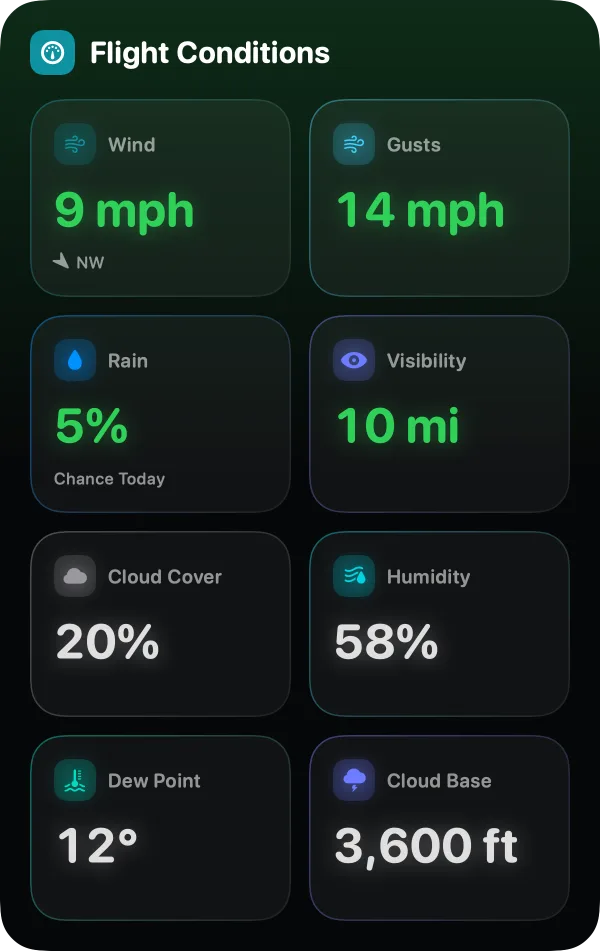
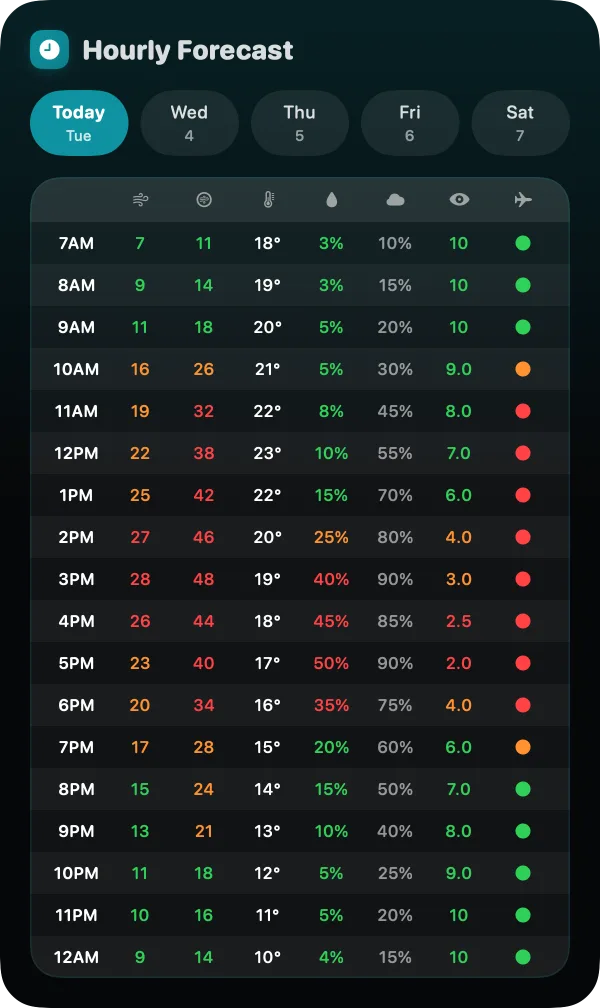
Flight conditions now, and the day ahead graded hour by hour.
The wind profile shows how the wind and gusts are likely to build with height, hour by hour, so you can see what your drone may meet at 120 m (400 ft), not just on the ground.
Add your drone’s wind rating under My Drones, and the “Can I fly here?” flight check holds the wind to your default drone’s rating. Once the wind or gusts reach 80% of the rating, it tells you you’re close to your drone’s limit, and at the rating, it says don’t fly. A sturdier drone never relaxes the general grades, though: 30 mph gusts are hard work for the pilot as well as the drone.
Common questions
Can I fly my drone in 20 mph wind?
Many small camera drones are rated for 24 mph, so on paper, yes. But 20 mph at ground level can be nearer 28 mph at 120 m, before gusts, which is more than that rating. Fly low and close to you, keep plenty of battery for the trip home, or wait for a calmer hour.
What wind speed is too much for a DJI Mini?
DJI rates the Mini 4 Pro for winds up to 10.7 m/s (24 mph), and the Mini 5 Pro up to 12 m/s (27 mph). Those are maximums, so keep the gusts at your flying height well below them, and remember the wind at 120 m is usually stronger than the forecast.
What does Level 5 wind resistance mean?
It’s how DJI labels the wind rating on some of its drones. Level 5 means the drone is built to handle winds up to 10.7 m/s (24 mph), which is the top of force 5, a fresh breeze, on the Beaufort scale. The DJI Neo is Level 4, up to 8 m/s (18 mph).
Is it windier higher up?
Usually, yes. Forecasts give the wind 10 m above the ground. Higher up, there’s less drag from the ground, trees and buildings, so over open ground the wind at 120 m is often around 40% stronger, and sometimes much more than that.
Does wind drain a drone’s battery faster?
Yes. The drone works harder to hold its position and to fly into the wind, and the trip home is slower if it’s into a headwind. Turn back earlier than you would on a calm day.
Before you fly on a windy day
- Check your drone’s wind rating.
- Look at the gusts, not just the average wind.
- Allow for stronger wind at 120 m than on the ground.
- Fly into the wind first, and turn back with plenty of battery left.
- Stay clear of the turbulent air behind buildings, trees and cliffs.
- If the drone is struggling, bring it lower and closer.
The guide to how to fly a drone safely covers the rest of the checks to make before take-off, from airspace to NOTAMs.